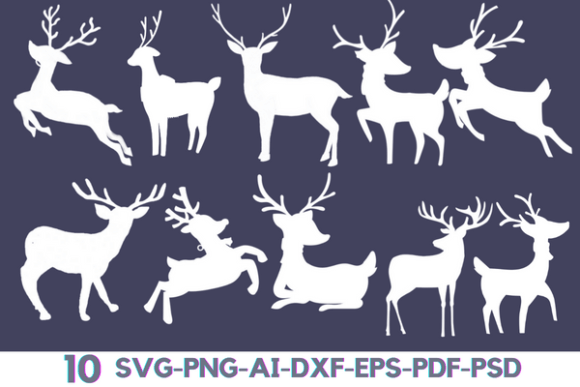
Christmas Deer Silhouette Bundle
A Designer’s First Look: Clean, Quiet, and Seasonally Sure
Unzipping the Christmas Deer Silhouette Bundle feels like opening a well-curated sketchbook—not flashy, but full of quiet intention. These 10 icons aren’t overloaded with antler flourishes or snowflake clutter. Instead, they’re lean, confident outlines: a leaping doe, a standing buck in profile, a fawn nestled under a pine bough—all distilled to their essential shape. As an embroidery designer who’s stitched hundreds of holiday motifs, I immediately sensed their strength: they’re built for clarity, not complication. That matters—especially when thread replaces ink.
Where This Bundle Earns Its Place on Real Projects
Last week, I used three icons from the Christmas Deer Silhouette Bundle to embroider a set of linen tea towels for a local boutique’s holiday launch. We chose a single deer facing left—mid-stride, no background, no fill—stitched in matte ecru thread on oat-colored fabric. The result? Crisp, tactile, and unmistakably handmade. Customers kept picking them up just to feel the stitch definition along the curve of the neck and the fine taper of the legs. That’s the real test: does it hold character *after* stitching? For this bundle, yes—especially on stable, medium-weight fabrics like cotton twill, canvas, or linen.
The simplicity also makes it adaptable across formats. I’ve tested one icon as a small embroidered patch (3.2” wide) on denim jackets—no puckering, no lost detail. Another worked beautifully as a minimalist sweatshirt chest emblem, where dense fill stitches would’ve overwhelmed the knit. And for baby embroidery? A tiny version (under 2”) stitched on organic cotton onesies held up perfectly after three rounds of gentle washing—no fraying, no distortion. That’s rare in holiday graphics, which often sacrifice durability for charm.
Where to Proceed Thoughtfully
That same elegance becomes a limitation in specific contexts—and it’s worth naming them honestly. On highly textured fabrics (like bouclé or thick terry cloth), the delicate negative space between antlers and body can fill in unpredictably. On stretchy knits without proper cutaway stabilizer, even a clean silhouette can distort slightly at the shoulders or haunches during hooping. And on dark fabric, especially with light thread, subtle contour lines may soften unless you increase stitch density just enough—or add a single-outline underlay.
I also wouldn’t push these icons into ultra-small hoop sizes (<2.5”) without checking how the legs, ears, and tail render in actual stitch. They’re not micro-detailed, but they *do* rely on proportion. A 1.5” version of the leaping deer lost its sense of motion—the legs blurred into a single shape. Likewise, avoid placing them directly over seams, curved surfaces like cap crowns, or layered garments (think reversible aprons) unless you’ve pre-tested alignment and tension.
How It Shapes Perception—Before and After Stitching
What surprises people most is how much visual weight a simple silhouette carries. When stitched cleanly, the Christmas Deer Silhouette Bundle reads as intentional, not minimal. It signals craftsmanship—not because it’s complex, but because it trusts the viewer to complete the story. That builds customer trust, especially for Etsy sellers or small shop owners positioning themselves as thoughtful makers, not mass producers.
It also elevates perceived value. A personalized gift—a monogrammed pillow cover with a single deer icon beside the name—feels curated, not templated. Same for boutique merchandise: a set of matching embroidered napkins using different icons from the bundle reads as cohesive design, not clipart repetition. And for digital product sellers? These work brilliantly in printable mockups—clean lines translate well to flat lay photos, and the consistent style helps build recognizable brand assets across listings.
Practical Notes Every Embroidery Designer Should Run Through
- Always test first—on scrap fabric *identical* to your final project, with the same stabilizer and thread colors you’ll use.
- Check contrast early: try black and white thread on both light and dark backgrounds before committing to a batch.
- Review stitch density: if your machine tends toward loose tension, a light pass of underlay can anchor those slender legs and antler tips.
- Confirm hoop size compatibility: while the icons scale well, verify that your largest intended version fits comfortably within your standard hoop—especially for multi-position projects like tote bag panels.
- Inspect corners and curves: zoom in on the file preview. Do sharp turns have appropriate pull compensation? If not, a quick digitizing tweak may be needed for crispness.
- Test in grayscale mockups: this reveals whether the design holds presence without color crutches—a sign it’ll translate well across products and seasons.
- Verify licensing scope: since the listing confirms suitability for personal *and* business use, double-check whether redistribution of the digital embroidery file itself is permitted—especially if you sell digital embroidery files or craft kits.
Final Thought: Less Is Anchored, Not Empty
The Christmas Deer Silhouette Bundle doesn’t shout “Christmas.” It whispers “winter,” “stillness,” “tradition”—in a way that feels handmade, not algorithmic. It’s not for every project: skip it if you need glittery, maximalist, or narrative-driven holiday graphics. But if your craft business values subtlety, longevity, and stitch-friendly design—whether you’re embroidering nursery decor, custom apparel, or small-batch boutique goods—this bundle earns its place in your working library. It’s the kind of machine embroidery design that looks better after it’s stitched than it does on screen. And in our line of work? That’s the highest compliment.