Rainbow Book, Education
As someone who’s stitched hundreds of designs onto everything from organic cotton baby onesies to heavyweight denim tote bags, I opened Rainbow Book, Education expecting cheerful simplicity—and found something more nuanced. It’s not just a playful icon; it’s a thoughtful visual anchor for learning-themed handmade products. I tested it first on a custom-embroidered canvas tote for a local preschool teacher’s back-to-school gift—soft fabric, medium hoop, standard tear-away stabilizer—and the result felt both intentional and warm.
A Design That Breathes With Your Project
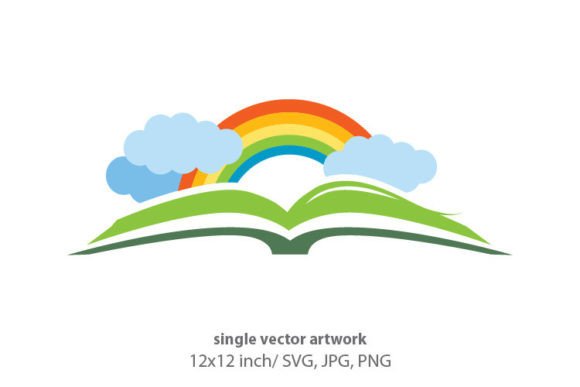
The first thing that stands out is how Rainbow Book, Education avoids visual clutter without sacrificing character. The vector-based construction (made in Adobe Illustrator, as noted) gives clean curves and balanced negative space—no jagged edges or pixelated corners, even when scaled down to 3 inches wide. That matters: when you’re stitching onto a curved surface like a baseball cap or a toddler’s knit beanie, crisp outlines hold up better than busy silhouettes. The rainbow arch wraps gently over an open book, suggesting growth, curiosity, and inclusivity—not just “school” but *learning as joy*. That emotional resonance translates directly into customer trust, especially for Etsy sellers offering personalized baby embroidery or boutique nursery decor.
Where It Shines—and Where It Asks for Care
Rainbow Book, Education works beautifully on medium-weight fabrics with stable weaves: cotton twill aprons, linen tea towels, midweight sweatshirts, and structured pillow covers. Its moderate detail level—clear book spine, distinct rainbow bands, soft rounded letters—translates well into satin stitch for outlines and smooth fill stitch for color blocks. I found it especially effective as a small embroidered patch (2.5–3.5 inches), heat-applied to denim jackets or sewn onto backpacks for kids’ summer camp gear.
But here’s where practical judgment kicks in: avoid using Rainbow Book, Education on highly textured fabrics like terry cloth or bouclé wool without extra stabilizing—it’ll mute fine transitions between rainbow hues. On stretchy knits (think baby bodysuits or lightweight tees), use cut-away stabilizer and reduce stitch density slightly to prevent puckering around the book’s curved edges. And while the design reads clearly on light fabric, test thread colors carefully on dark backgrounds—the RGB palette doesn’t auto-adjust contrast. A rich navy or charcoal base needs brighter thread choices (think lemon yellow instead of pale gold) to keep the rainbow legible after stitching.
Real Use, Real Impact
I recently used Rainbow Book, Education on a set of hand-stitched kitchen towels for a Montessori-inspired home goods shop. Customers responded not just to the imagery, but to how *finished* it looked—no fuzzy edges, no lost details in the binding of the book, no muddy transitions between red and violet. That polish elevates perceived value: buyers associate clean execution with care, craftsmanship, and brand consistency. For small shop owners, that means repeat orders. For craft fair vendors, it means people pausing at your booth—not just glancing.
It also performs well in digital contexts. Because it’s delivered as SVG, JPG, and PNG files (12×12 inches at 300 dpi), it scales cleanly for printable mockups—perfect for Etsy listings showing the design on a mock sweatshirt or tote bag. Just remember: the SVG file is ideal for resizing without loss, but your embroidery digitizer will need the actual machine embroidery file (not included here). This is a digital graph, not a pre-digitized machine embroidery design—so treat it as foundational art, not plug-and-play stitch data.
Smart Prep Tips Every Embroidery Designer Should Run Through
- Test on scrap fabric first—especially if stitching on textured, dark, or stretchy material.
- Check thread color contrast before stitching the full run; what looks vibrant on screen may fade on fabric.
- Review stitch density if converting this graphic into a machine embroidery file—dense fills near the rainbow’s inner curve can cause stiffness on lightweight garments.
- Confirm hoop size compatibility—the 12×12 artboard gives flexibility, but your final stitched version should comfortably fit within your most-used hoop.
- Inspect small details at 200% zoom: the book’s pages, rainbow band separation, and subtle shadow under the arch all affect clarity at smaller sizes.
- Try black-and-white mockups to assess silhouette strength—if it reads well in grayscale, it’ll hold up across fabric types and lighting conditions.
- Compare light/dark fabric backgrounds in your design software before digitizing or listing.
- Use proper stabilizer—lightweight cut-away for knits, tear-away for stable wovens, and fusible for patches.
- Verify licensing before selling finished embroidered items or reselling the digital file—this is a graphics asset, not automatically cleared for commercial redistribution.
Making It Yours—Without Losing Its Heart
What makes Rainbow Book, Education stand out among education-themed icons isn’t just its vector precision—it’s its quiet versatility. It doesn’t scream “school.” It whispers “wonder.” That subtlety lets it live across seasons and audiences: as holiday embroidery on a child’s stocking, as wedding gift embroidery on a storybook-themed guest book cover, or as boutique branding on a line of handmade children’s notebooks. For Etsy sellers bundling digital design assets, it pairs naturally with coordinating alphabet motifs or simple chalkboard-style frames—just keep spacing generous to preserve its breathing room.
If you’re building a craft business around meaningful, handmade product storytelling, Rainbow Book, Education isn’t just decoration. It’s a quiet ambassador—of patience, of play, of purposeful making. Used thoughtfully, it supports your voice instead of competing with it. And in a market flooded with generic clipart, that kind of intentionality? That’s what turns a nice embroidered patch into a keepsake.